Blog Contents Kit
FRAMER COMPONENT · BLOG
Connect your CMS article once. The contents, the section you’re reading, a progress bar and the reading time come from it. No network requests.

Every loaf we serve at Lumbre starts the evening before, in a glass jar on the shelf above the oven. The starter in that jar is older than the kitchen itself: it came with Rosa, who baked for the village for thirty years, and it has been fed almost every day since. This is how a loaf goes from that jar to your table, and why we still do it the slow way.
Why we bake with a starter#
Bread made with commercial yeast is ready in three hours. Ours takes closer to thirty. The time is not nostalgia: it is what gives the crumb its open holes, the crust its colour and the loaf its slight sourness, the kind you notice with butter and forget with cheese.
Slow fermentation also does part of the digestion for you. The bacteria in the starter break down some of the flour's starches and gluten before the dough ever reaches the oven, which is why guests who avoid bread at home often take a second slice here.
A good loaf is mostly waiting. The baker's job is to know when to stop waiting.
Feeding it the night before#
Around nine in the evening, whoever closes the kitchen feeds the starter: equal weights of flour and water, stirred in with a wooden spoon. Then the jar goes back to its warm corner.
What a healthy starter looks like#
By morning it has doubled and its top is domed, not sunken.
It smells of yoghurt and green apples, never of nail varnish.
A spoonful dropped in water floats.
If it fails any of the three, we feed it again and wait. Bread made from a tired starter is heavy, and no amount of oven heat will fix that.
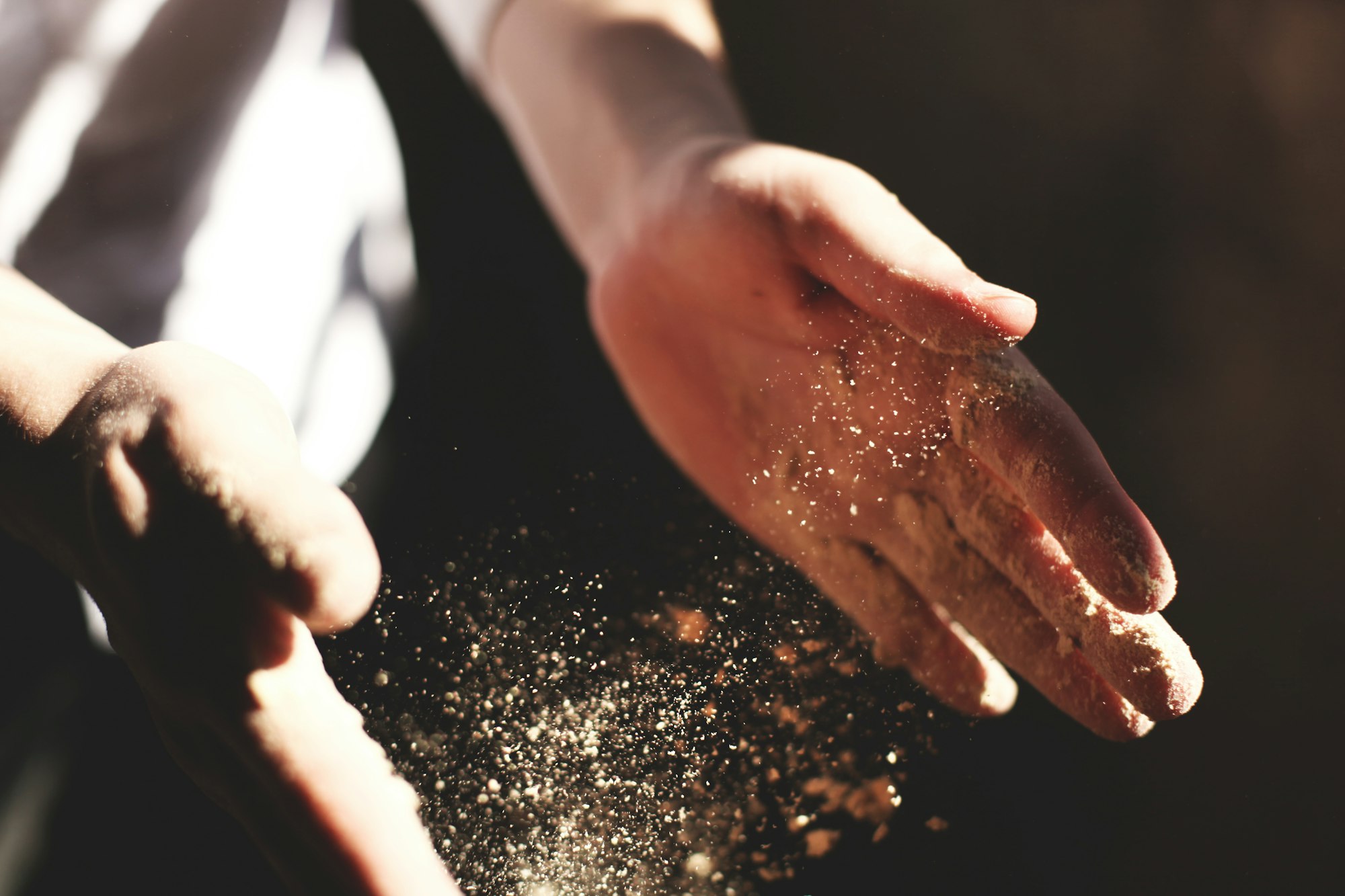
Rye from the mill in Valderrobres goes in with the white flour.
Flour from the valley#
We mix a white bread flour with about fifteen per cent wholemeal rye from the mill in Valderrobres. The rye gives the starter something to chew on and the bread a darker, nuttier crumb. The mill grinds it once a week, so we never keep more than a fortnight's worth.
Mixing, folding and the long rest#
At seven the next morning the starter goes into a large bowl with flour, water and, an hour later, salt. There is no kneading. Instead, the dough is folded four times over two hours: a hand under one side, lifted and laid over the other, a quarter turn of the bowl, again.
First fold: the dough is shaggy and tears easily.
Second fold: it starts to hold together.
Third fold: it stretches without tearing.
Fourth fold: it is smooth, airy and jiggles when the bowl moves.
After the folds it rests, covered, until it has grown by about half. In summer that is three hours; in January it can be six.
Shaping#
The dough is turned out, divided by eye and shaped into rounds with as little flour as possible. Each round goes seam up into a basket lined with a linen cloth, and the baskets go into the cold room overnight.
Into the wood oven#
The oven is lit at six, with oak and a few olive prunings for a fast, clean heat. By eight the floor is white hot and the fire is pushed to the back. The loaves are turned out onto a peel, scored once with a razor and slid onto the stone.
For the first twenty minutes the door stays closed, so the steam from the dough keeps the crust soft long enough for the loaf to rise. Then the door opens, the steam leaves and the crust starts to colour. Forty minutes in all, give or take the weather.
Forty minutes on the stone, the door closed for the first twenty.
Bread at the table#
The loaves cool on a rack by the kitchen window until lunch. We cut them at the table, with this year's oil from the mill and a little salt, and what is left becomes breadcrumbs for the evening's stew. Nothing goes in the bin.
If you would like to bake it yourself, we run a sourdough workshop most months. You go home with a loaf, a jar of our starter and Rosa's notes, which are better than these.
Live component. The article is a Framer CMS item: Article Body shows its formatted text, and the contents and reading time read from it. Scroll the article to see the current section follow you.
MAKE IT YOURS
Your fonts, your colours, any place on the page.
Three layouts, a rail that fills as you read, a pill for the current section, numbers and a progress bar. These three read the article above.
Rail on dark
Numbers and a rail that fills to the section being read, in a warm accent.
Pill and progress
Only the main sections, the current one on a pill and how much is left below.
Box in the article
Folds open at the top of the article, for pages without a sidebar.
ONE FIELD
Connect the article once. The rest reads from it.
01
Article Body
On your blog’s CMS page, place Article Body and connect Body to the formatted text field. Every heading gets an anchor; add a drop cap if you like.
02
Table of Contents
Place it in a sidebar, above the article or in a sticky bar. It lists the headings and follows the reader.
03
Progress and time
A reading bar for the top of the page and the reading time for next to the date. Both read the same article.
WHAT’S INSIDE
Built for blogs, guides, docs and long case studies.
Framer’s rich text doesn’t give headings anchors, so a table of contents has nothing to link to. Article Body adds them, and keeps them stable so links to a section keep working.
Three layouts
A rail that fills as you read
Current section highlighted
Drop cap and large quotes
Smooth scroll with an offset
Reading progress bar
Reading time
Links to any section
H2 or H2 + H3
Numbers
Your article’s typography
Keyboard and screen readers
No network requests